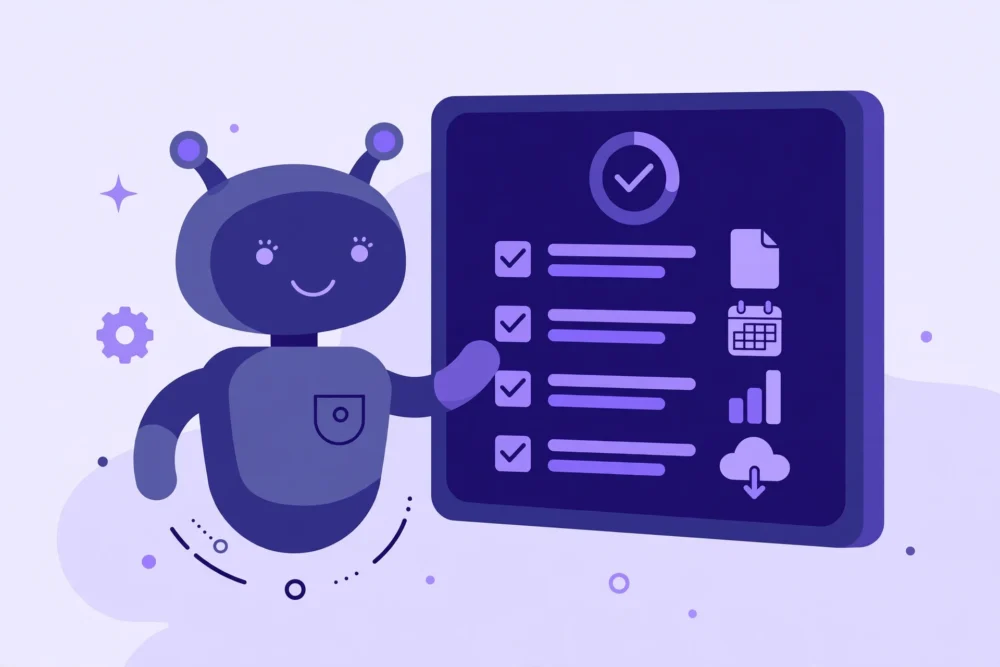
You may have heard the term “AI agent” used for everything from a chatbot to a robot. The idea is actually simple: an AI agent is a system that can perceive a situation, decide what to do, and take actions toward a goal — not just answer one question and stop.
Agent vs. Chatbot: The Key Difference
A chatbot responds to your message and waits for the next one. It does not remember a goal across many steps, and it does not act on its own. An agent, by contrast, is given a goal (“book the cheapest flight that arrives before noon”) and works through the steps itself: searching options, comparing prices, checking constraints, and reporting back — asking you only when a decision needs your approval.
Think of it this way: a chatbot is like asking a knowledgeable friend a question. An agent is like giving a capable assistant a task and checking the result.
How an Agent Works
Most agents follow a loop: observe, think, act, and repeat. They observe information (a message, a web page, a file), think about the next step (often by reasoning with a language model), act (searching, sending a message, running a tool), and then observe the result and decide what to do next. They stop when the goal is reached, when they need your input, or when they hit a limit you set.
Agents often use tools: web search, calculators, calendars, or connections to other software. The tools are what turn a language model from a text generator into something that can do work in the world.
Everyday Examples
- A customer-service agent that checks your order status, finds the delivery problem, and arranges a replacement without transferring you between departments.
- A research agent that gathers sources on a topic, summarizes them, and flags contradictions.
- A coding assistant that does not just suggest code, but runs tests, fixes errors, and reports what changed.
- A travel agent that compares flights and hotels against your budget and dates, then presents the best few options.
What Agents Cannot Do Well Yet
Agents are useful, but they have real limits. They can misunderstand a vague goal and confidently do the wrong thing. They can get stuck in loops, repeat failed steps, or make mistakes with tools. They do not truly understand consequences the way a person does, which is why important actions — spending money, sending messages on your behalf, changing settings — should always need your approval or clear limits set in advance.
Using Agents Safely
Give agents specific goals, not open-ended ones: “summarize these three articles” beats “do some research.” Set limits: a budget, a list of allowed actions, and which decisions must come back to you. Always check the result before it becomes final, especially for anything involving money, messages to other people, or personal data. And keep private information out of prompts unless you know where it goes.
Common Mistakes
- Assuming an agent understands your goal when you have not stated it clearly.
- Letting an agent take irreversible actions without approval.
- Trusting an agent’s output without checking, especially numbers and facts.
- Confusing a chatbot with an agent — and expecting a chatbot to complete multi-step tasks on its own.
Worked Example: Giving an Agent a Good Task (and a Bad One)
The difference between a useful agent and a frustrating one is usually the task description. Compare these two requests for a travel-planning agent:
Bad task: “Plan a holiday for me.” This is vague in every direction: no destination, no dates, no budget, no travellers, no preferences. An agent given this task will either ask endless clarifying questions, or guess — and a guessed holiday is rarely the holiday you wanted. If it books anything, it may book the wrong thing confidently.
Good task: “Find three flight options from London to Rome for two adults, departing 12 June and returning 19 June, under £400 per person in total, arriving before noon on the outbound flight. Present the options in a table with price, times, and baggage included. Do not book anything; I will choose.”
This task works because it states the goal, the constraints (dates, travellers, budget, arrival time), the output format (a table), and the limit (no booking without approval). The agent can search, compare, and report, and the human keeps the final decision. Notice the pattern: goal, constraints, format, limits. Use that pattern for any agent task, whether it is research, coding, or customer service.
Now imagine the agent returns an option that looks perfect but costs £450. A good agent should flag the constraint it broke, not hide it: “This option is £50 over budget, but arrives before noon and includes baggage.” When you check an agent’s work, look for exactly that honesty about constraints — it is the sign of a well-designed agent, and its absence is a warning.
Agents in the Wild: Where You Already Meet Them
You may already use agents without calling them that. A smart email assistant that sorts messages, drafts replies, and schedules meetings from your instructions is acting as an agent for a narrow goal. A shopping assistant that tracks a price, alerts you when it drops, and shows you alternatives is an agent with a single, clear task. A code assistant that runs your tests after each change and reports failures is an agent for a development workflow.
The common thread is not the technology, but the pattern: a goal that lasts longer than one question, steps taken without asking at each step, and tools used to act in the world. Once you see that pattern, you can judge new “agent” products more clearly. Ask: what goal does it pursue, what tools can it use, what limits does it respect, and what decisions come back to me? A product that cannot answer those questions clearly is probably a chatbot with a new label, not an agent.
This also explains why agents feel impressive and unreliable at the same time. The same loop that lets an agent complete ten steps on its own also lets it take ten wrong steps on its own, if the goal was vague or a tool returned bad data. That is why the safety advice in this article — specific goals, clear limits, and checking results — is not optional caution; it is the core skill of using agents well.
More Common Mistakes to Avoid
Giving an agent your passwords or private data in the prompt. An agent may need access to a service to do its job, but that access should come through a proper connection or permission you control, not by pasting credentials into a chat. If an agent asks for a password in plain text, stop and check how it will store and use it.
Letting an agent send messages in your name without review. A draft is safe; a sent message is not. Until you trust an agent’s tone and judgment for a specific task, keep sending as a human-approved step, and review the first dozen outputs before relaxing that rule.
Assuming an agent remembers everything forever. Many agents have limited memory, or memory that resets between sessions. If a preference matters — a budget, a dietary restriction, a naming rule — state it in each important task, or check that the agent’s memory actually persists. Do not assume a preference mentioned once will be remembered next month.
Judging an agent by its best demo, not its everyday work. Demos use clean, well-defined tasks. Real work is messier: vague goals, missing data, and tools that fail. Test an agent on a real, small task from your own work before trusting it with an important one.
Your Agent Checklist
- Goal stated in one sentence, with constraints: budget, dates, format, and limits.
- Decisions that need my approval named in advance — especially money, messages, and settings.
- Tools the agent may use listed, and private data kept out of prompts unless the handling is clear.
- Result checked before it becomes final, especially numbers, names, and dates.
- A stop condition set: when to stop, when to ask, and what to do if a tool fails.
Conclusion
An AI agent is not magic, and it is not just a chatbot with a new name. It is a system that pursues a goal through steps, using tools, and reporting back. Used with specific goals, clear limits, and human checking, it can save real time on well-defined work. Used with vague goals and unchecked actions, it can confidently do the wrong thing at speed. The skill is not in finding the most powerful agent, but in giving any agent a task worth doing, with limits worth respecting.
FAQ
Is an AI agent a robot? Not necessarily. Most agents are software, not physical machines. A robot can be an agent, but most agents live entirely in software.
Do I need to know programming to use an agent? No. Many agents are built into apps you already use. Programming helps if you want to build one, not to use one.
Will agents replace human assistants? They are best at well-defined, repetitive work with clear goals. Judgment calls, relationships, and responsibility still belong to people — agents are tools that extend what one person can do, not replacements for accountability.